📘 Diffusion of Innovation Theory | 📅 1962 | 👤 Everett Rogers
The Diffusion of Innovation Theory was introduced by Everett M. Rogers in his landmark book:
“Diffusion of Innovations” (1st Edition, 1962)
In that book, Rogers proposed both:
-
📊 The Diffusion of Innovation Theory (population-level perspective)
-
🧠 The Innovation Adoption Process Model (individual-level decision-making)
The theory outlines how, why, and at what rate new innovations are adopted, offering insights into the factors that determine whether an innovation will be successful within a community or society.
🧩 A. Five Factors Influencing Adoption of Innovation
E.M. Rogers identified five key factors that influence how quickly and effectively an innovation is adopted:
-
⚖️ Relative Advantage – Is the innovation better than what it replaces?
-
🔗 Compatibility – Is it consistent with existing values and practices?
-
❓ Complexity – Is it difficult to understand and use?
-
🧪 Trialability – Can it be experimented with on a limited basis before full adoption?
-
👀 Observability – Are the results visible to others?
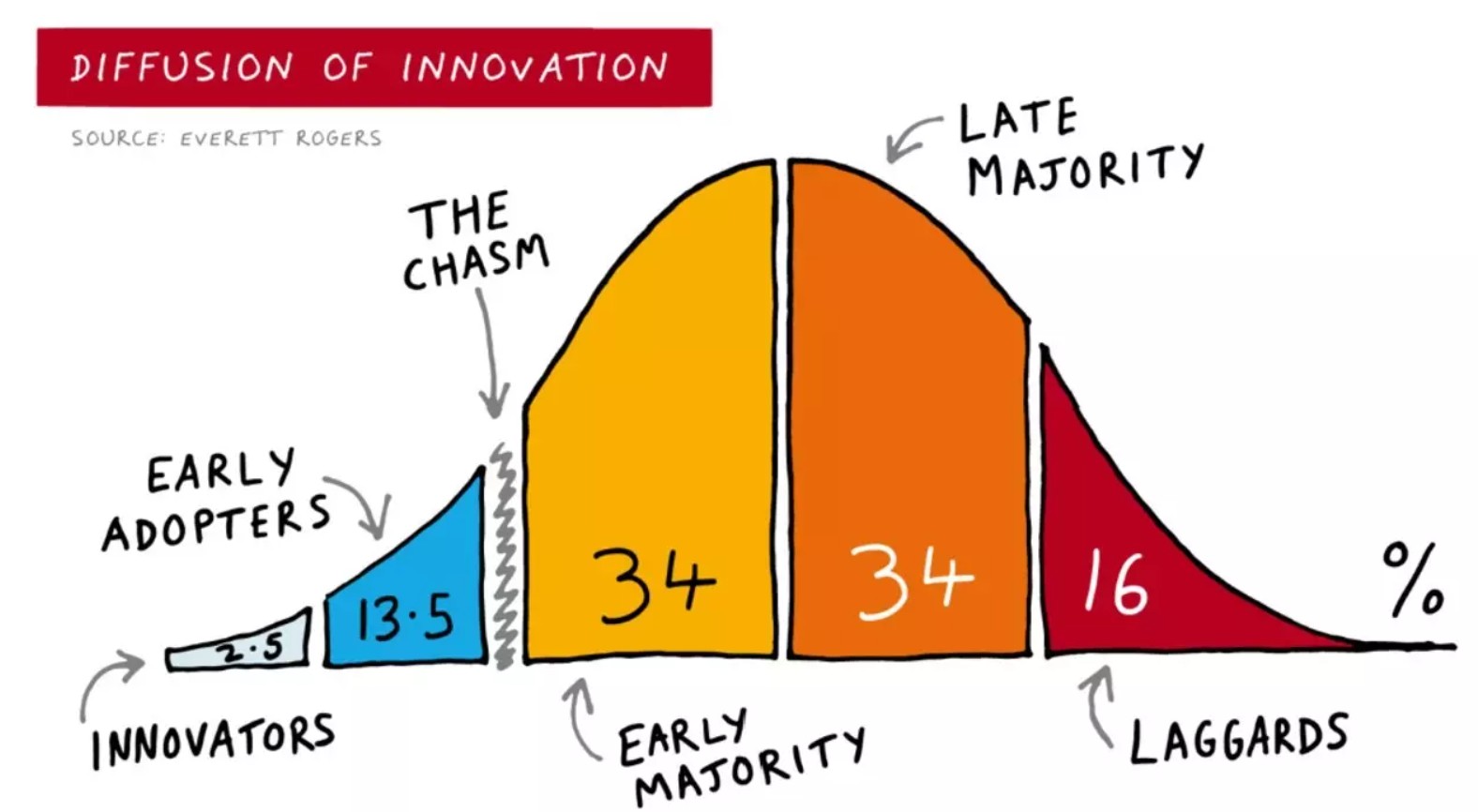
👥 B. Categories of Adopters
Rogers classified individuals into five categories based on their speed and timing of adoption:
🚀 Innovators (2.5%) aka Venturesome
-
First to adopt an innovation.
-
Risk-takers and eager to experiment.
-
Have access to resources or networks that facilitate early adoption.
-
Crucial in introducing innovations into the social system.
🌟 Early Adopters (13.5%) aka Opinion Leaders
-
More deliberate than innovators.
-
Often opinion leaders with higher social status.
-
Play a vital role in influencing others and spreading awareness.
🧩 Early Majority (34%) aka Deliberate
-
Cautious but adopt after seeing proven benefits.
-
Represent a critical mass for widespread adoption.
-
Their involvement marks the point at which an innovation begins to become mainstream.
⏳ Late Majority (34%) aka Skeptical
-
Skeptical and conservative.
-
Adopt only after most of society has.
-
Driven by peer pressure or economic necessity.
🐢 Laggards (16%) aka Tradition bound
-
Last to adopt innovations.
-
Highly resistant to change, often adopting only when absolutely necessary.
-
Tend to be traditional and less socially connected.